

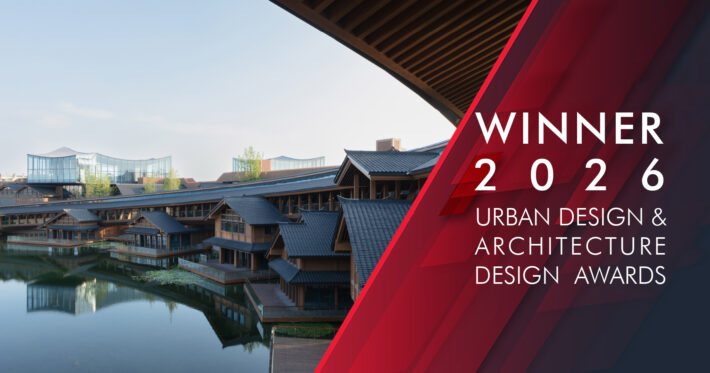
The project is situated in the heart of Pengzhou’s old town, historically the most vibrant area in the city. Addressing the area’s deficiency in public facilities, BIAD-ASA Studio introduces a mix of commercial and cultural functions, including retail spaces, dining establishments, hotels, an art gallery, a library, an exhibition hall, a civic activity center, and an urban park plaza.
Urban Design & Architecture Design Awards 2027: Entries Open!
Take your work to the next level. Register Now…

Gold 🏆 Winner
Urban Design & Architecture Design Awards 2026
Regional Urban Renewal of Chengdu Pengzhou Longxing Temple Area
Mixed-Use Architecture (Built)
Firm
BIAD-ASA Studio
Architect/Designer
Luoyi Yin
Design Team
Leader designer:Luoyi Yin Urban planning/Urban Design: Shengnan Guo, Xiaofeng Zhang, Wei Li, Xinda Tang, Shuang Luo, Xiyun Shang Architectural design: Feng Xu, Xiangyuan Kong, Fangfei Chen, Li Cheng, Ning Ni, Jianwei Li, Haonan Wang Landscape design: Ling Ding, Di Su, Xue Zhai, Jie Yang, Yixin Chen Commercial space design: Xin He, Jianxian Lin, Shuwen Luo, Ping Wang Interior design: Jianjun Li, Xiangyuan Kong Construction drawing design: Construction drawings for ABE plot buildings:Xianrong Li, Wei Li, Wei Gao, Bo Zhang, Jianhao Song / Construction drawings for CD plot buildings: Hong Zhou, Run Zhou, Wei Kong, Na Zhao, Yan Pei, Yuexing Wang, Sijia Li, Peng Yang, Xiangyu Wang / Structural construction drawings: Shichang Duan, Longgui Bu, Zhijun Gao, Yiqiao Tang, Juehui Xing, Litao Wang, Zixuan Bai / Construction drawings for water. electricity, HVAC equipment: Liang Sun, Peng Liang, Jiashan Zheng, Mo Zhang, Meng Zhao, Boxuan Yan Business plan: CUSHMAN & WAKEFIELD, Zhongying Renhe (Beijing) Commercial Managemen
Location
Pengzhou, Chengdu, China
Country
China
Photographer/Copyright
©arch-exist
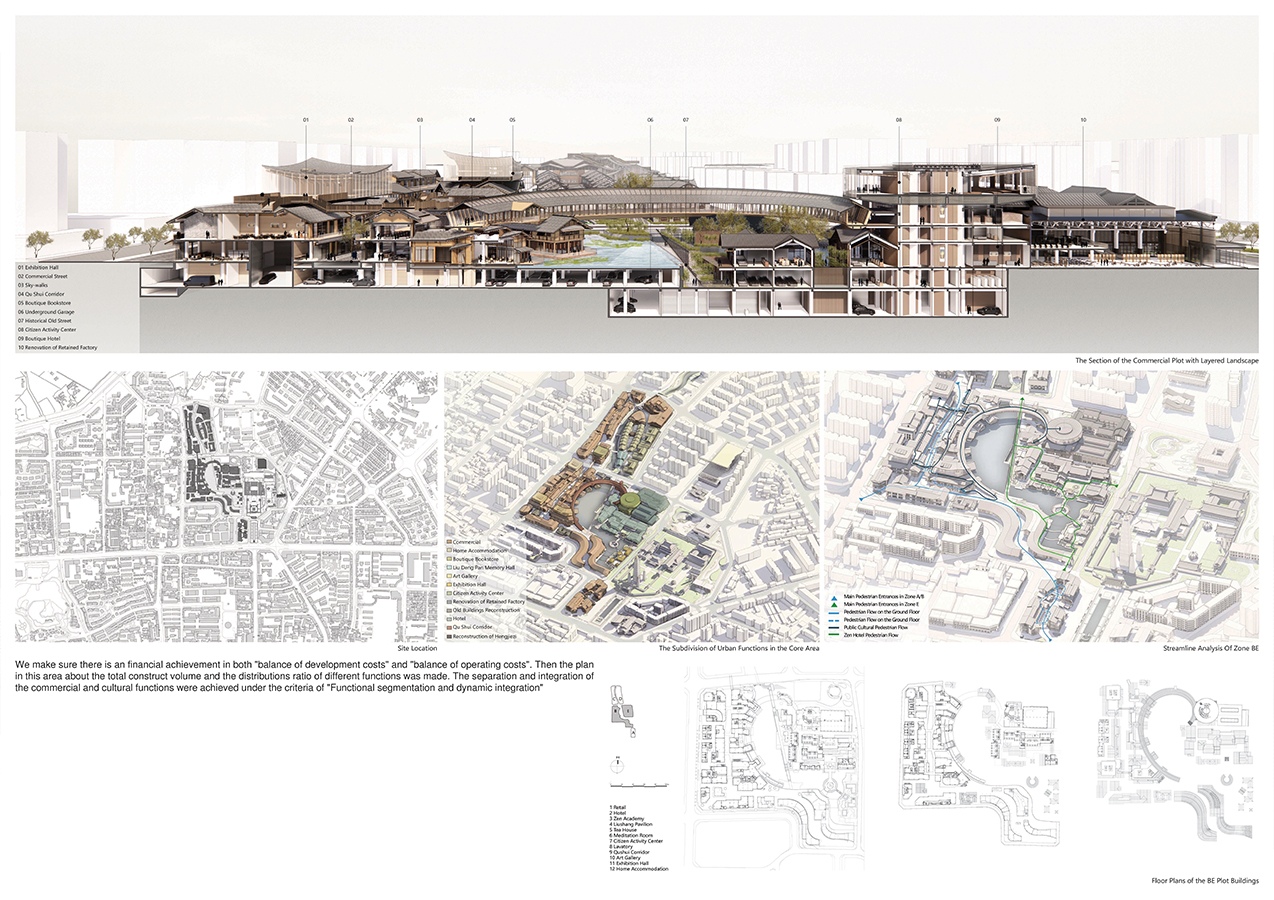
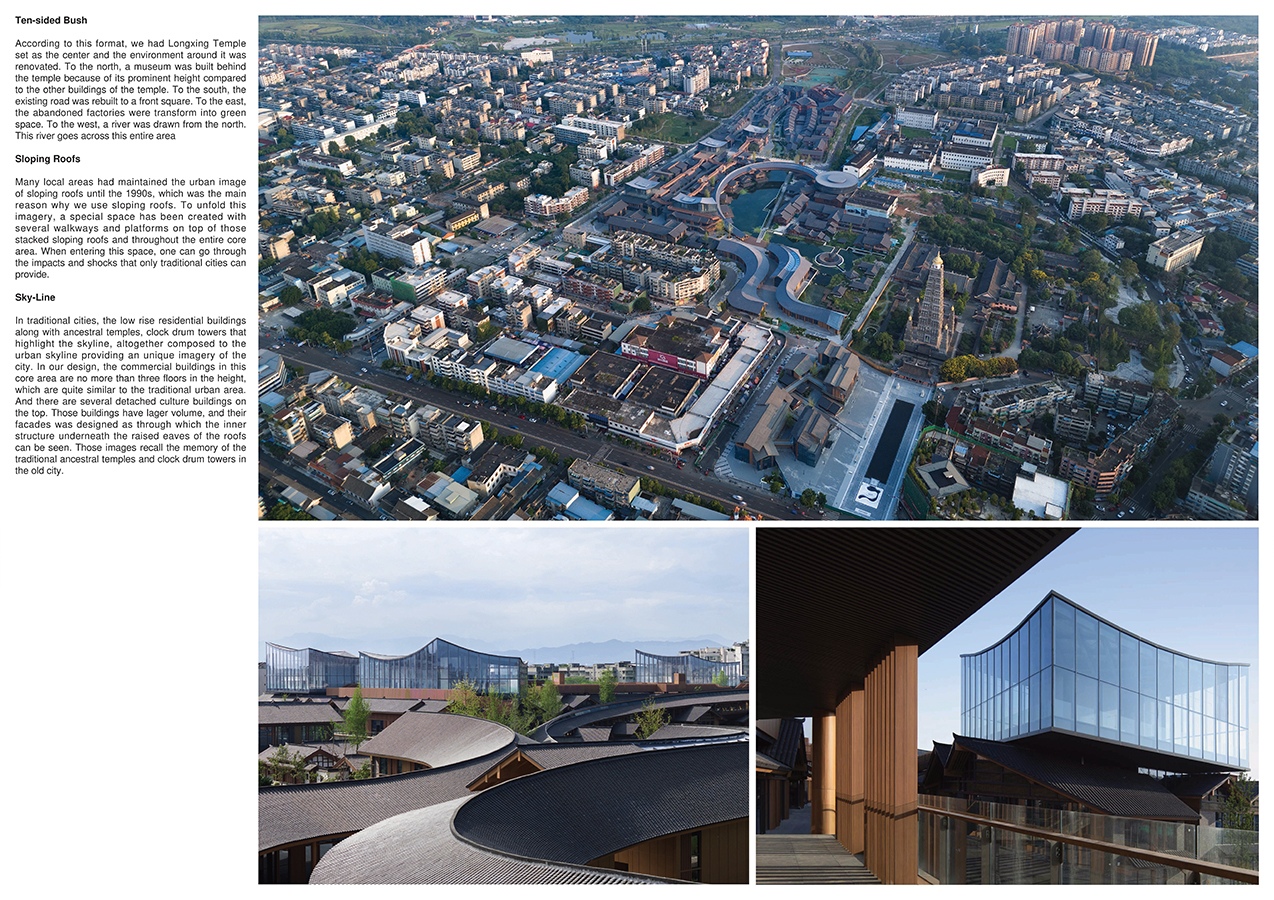
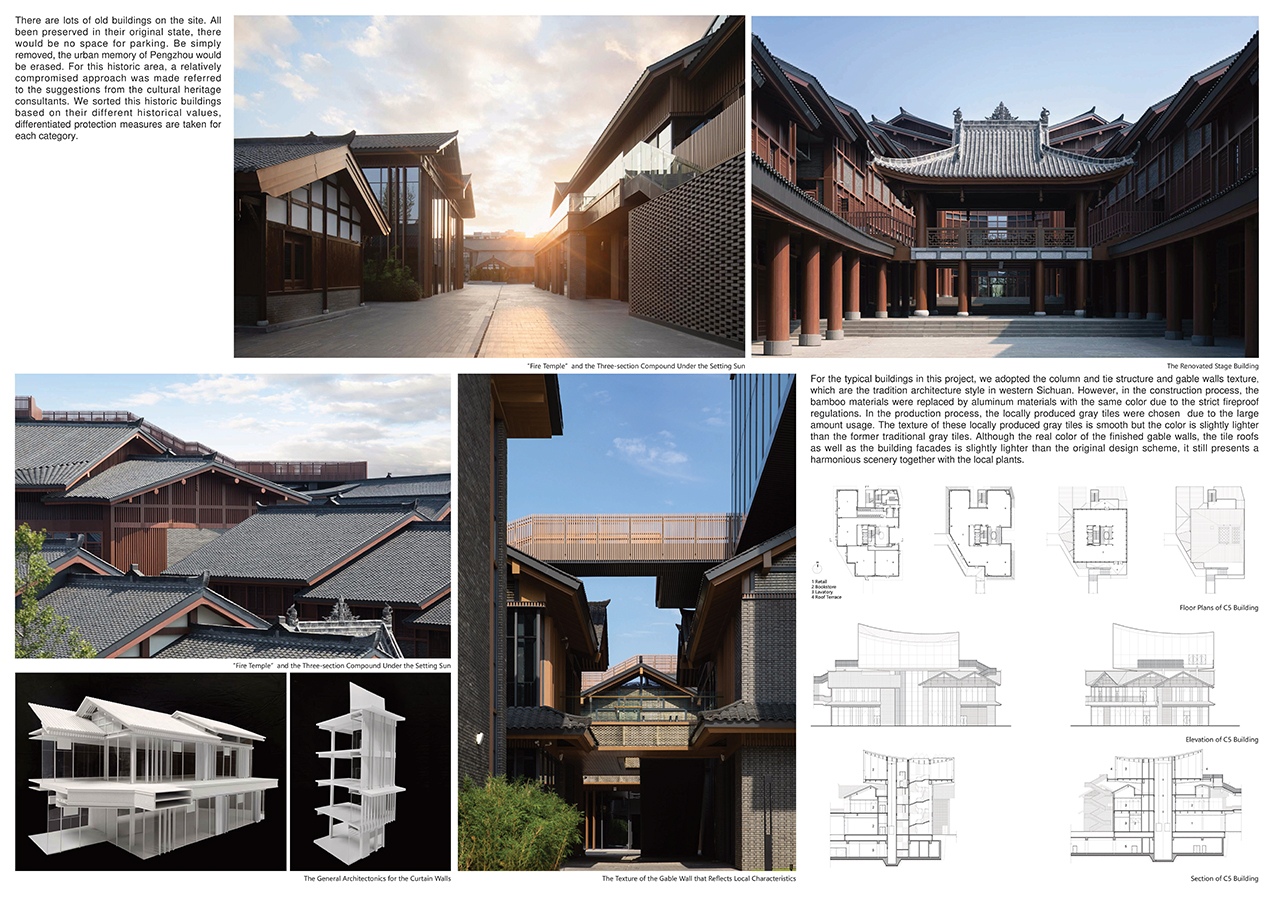
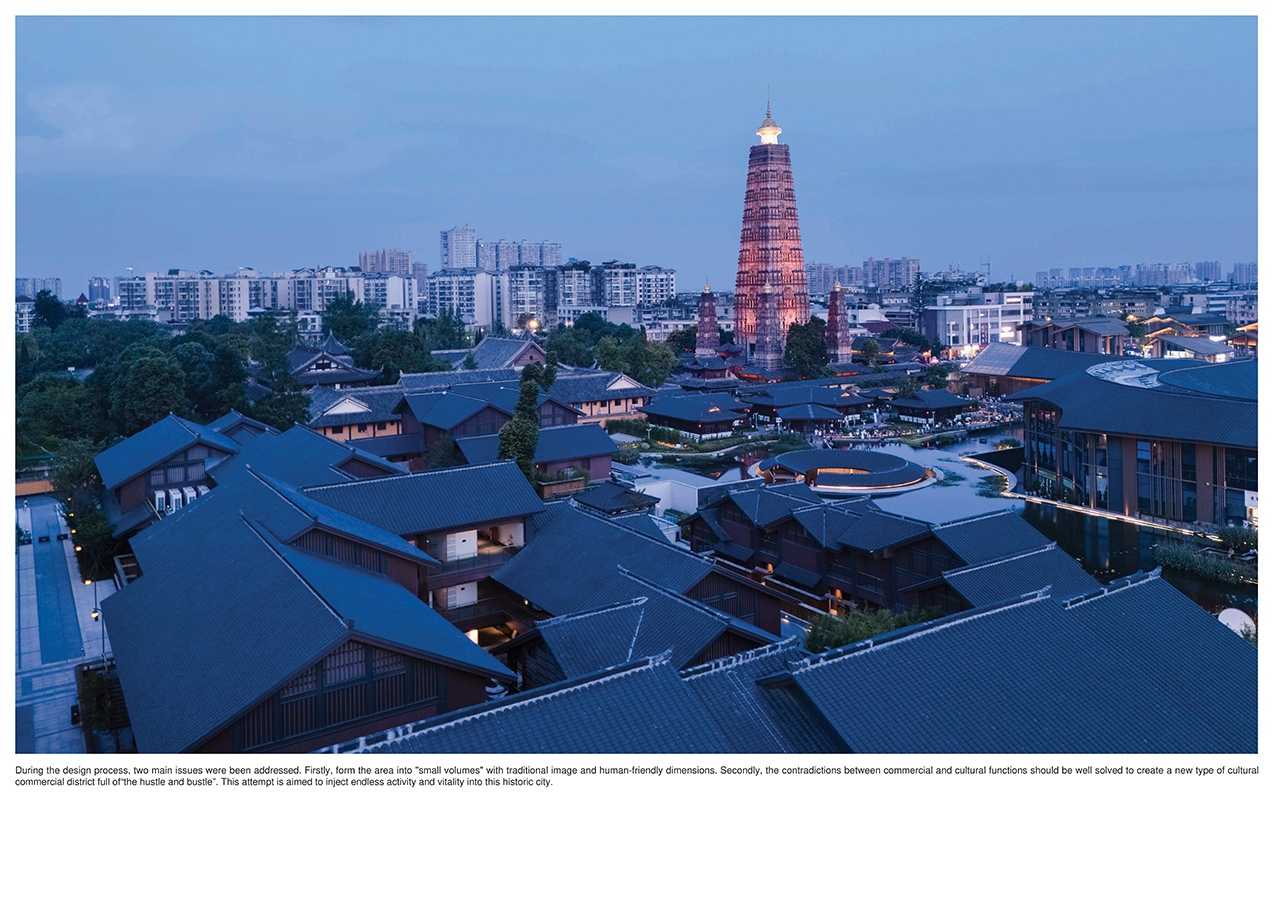
Inspired by traditional Chinese urban imagery, the design incorporates three representative elements into its identity and spatial organization. The layout adopts the concept of the “Ten-sided Bushes of Buddha” with the temple serving as the central focal point. North stands a museum that exceeds the height of the temple buildings; south an open forecourt; east a repurposed green space created from a disused factory; and west a flowing water feature integrates with the area. The “Sloped roofs” reminiscent of Pengzhou’s 1990s urban imagery, are reinterpreted as independent public spaces, interlinked by aerial walkways and platforms that traverse the site. Three-story primary buildings evoke the traditional style of residential and commercial structures. In contrast, larger cultural buildings feature upturned eaves and take inspiration from temple bell towers, collectively creating a dynamic ” Skyline in memory”.
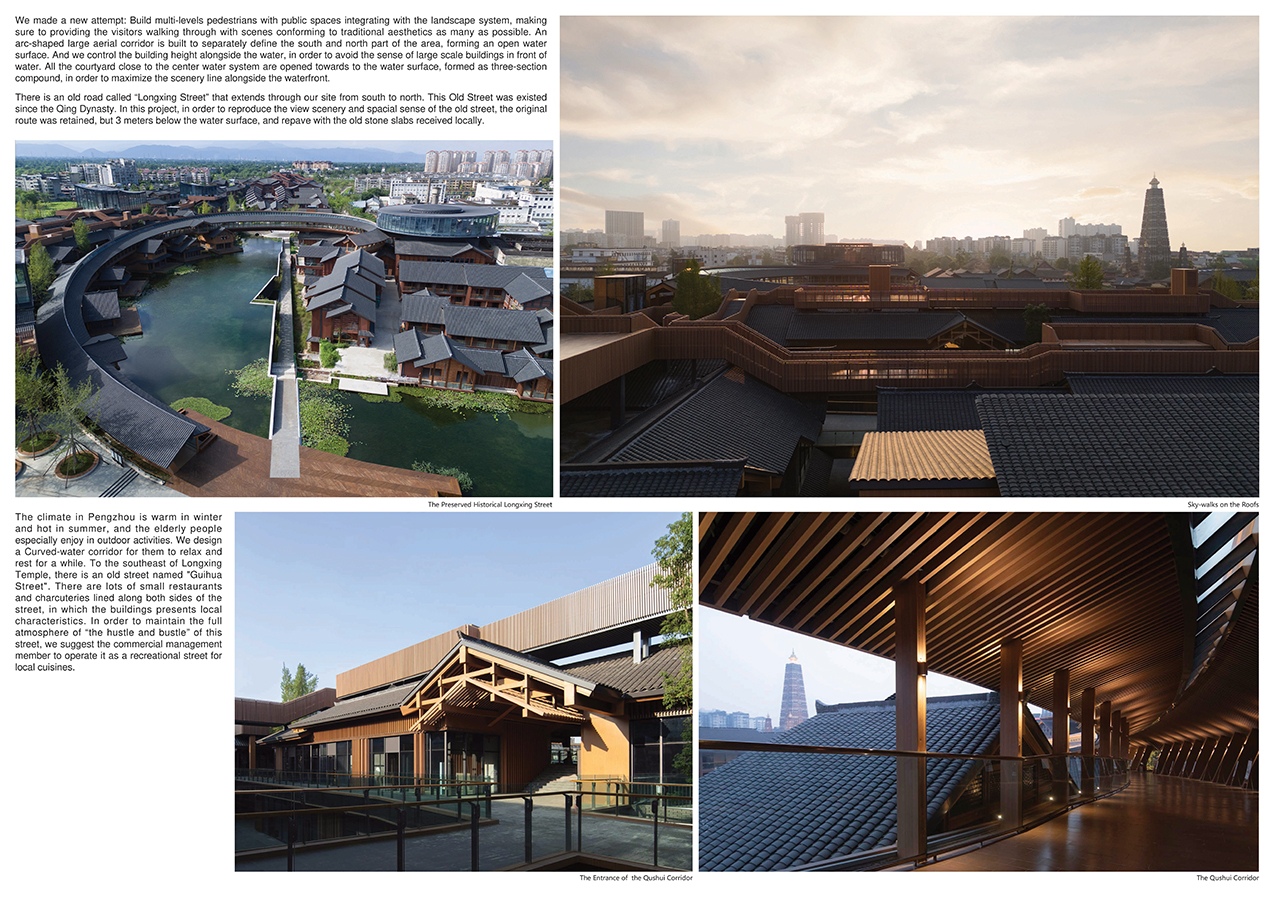
The design harmonizes key pedestrian public spaces with layered landscapes offering changing vistas. A gently ascending aerial corridor surrounds a tranquil water surface, with building heights intentionally reduced in proximity to the water to enhance the visual experience. Landscape courtyards extend the connection to the water, while the historic “Longxing Street,” dating back to the Qing Dynasty, is preserved in its original alignment and scale through a sunken design approach.
Ultimately, the design achieves a balance between modern architectural functionality and the creation of intimate, human-scaled spaces offering a contemporary interpretation of traditional spatial concepts. This project redefines urban center, blending historical context with innovative urban planning.