

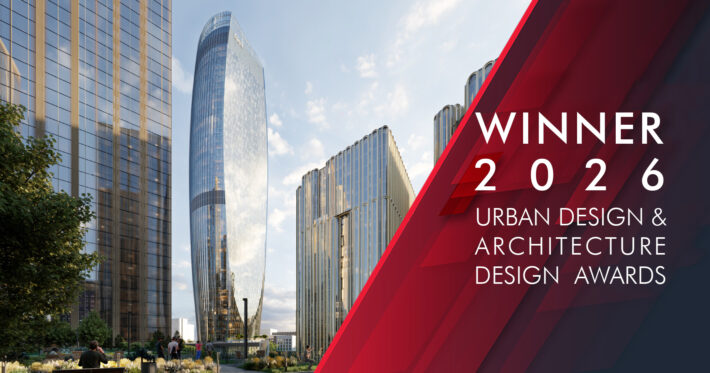
A tower with a “cut-off” facade will appear in the Begovy district. The total area of the business complex will be 88.5 thousand square meters.
The silhouette tower with a height of 225 meters will be made of structural glazing, the image will be complemented by lamellas with facade lighting built into the end.
Urban Design & Architecture Design Awards 2027: Entries Open!
Take your work to the next level. Register Now…

Gold 🏆 Winner
Urban Design & Architecture Design Awards 2026
Business Center BELL
Office Building (Under Construction)
Firm
UNK
Architect/Designer
Yuliy Borisov
Design Team
Head of the author team, Yuliy Borisov; head of the project, Olga Reunova; chief architect, Alexander Smirnov; leading architects, Vsevolod Zolotov, Gayk Torozyan, Veronika Medvedeva, Anna Romanskaya, Olga Vashkovets, Andrey Torbin; visualizers, Dmitry Zakharov and Adel Khakimullin
Location
Moscow. Russia
Country
Russia
Photographer/Copyright
©UNK/ visualizers, Dmitry Zakharov and Adel Khakimullin
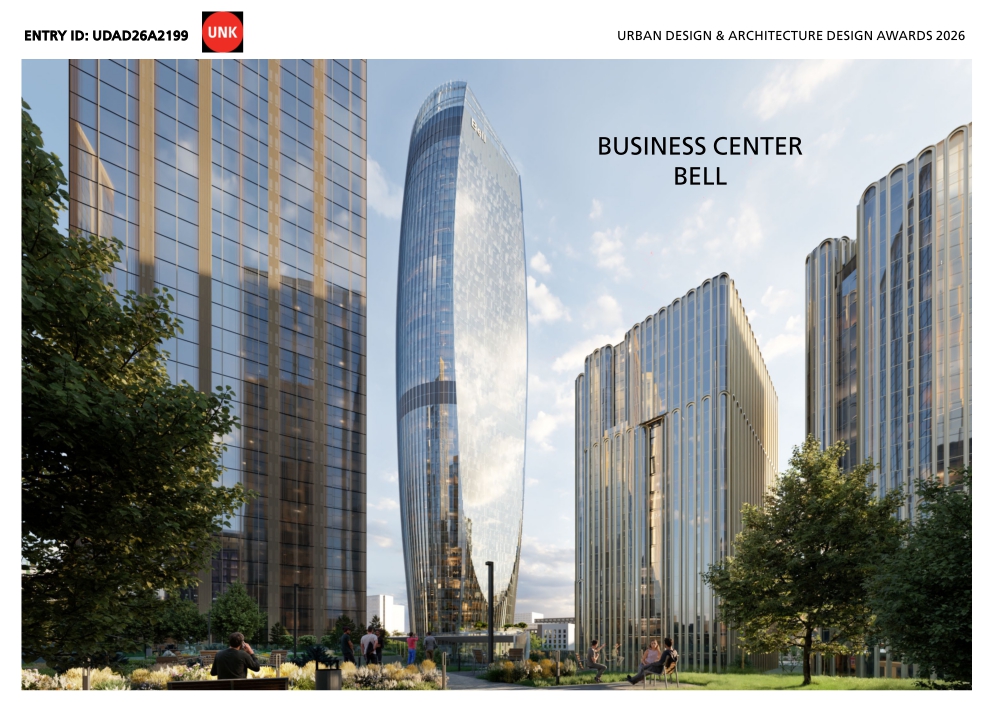


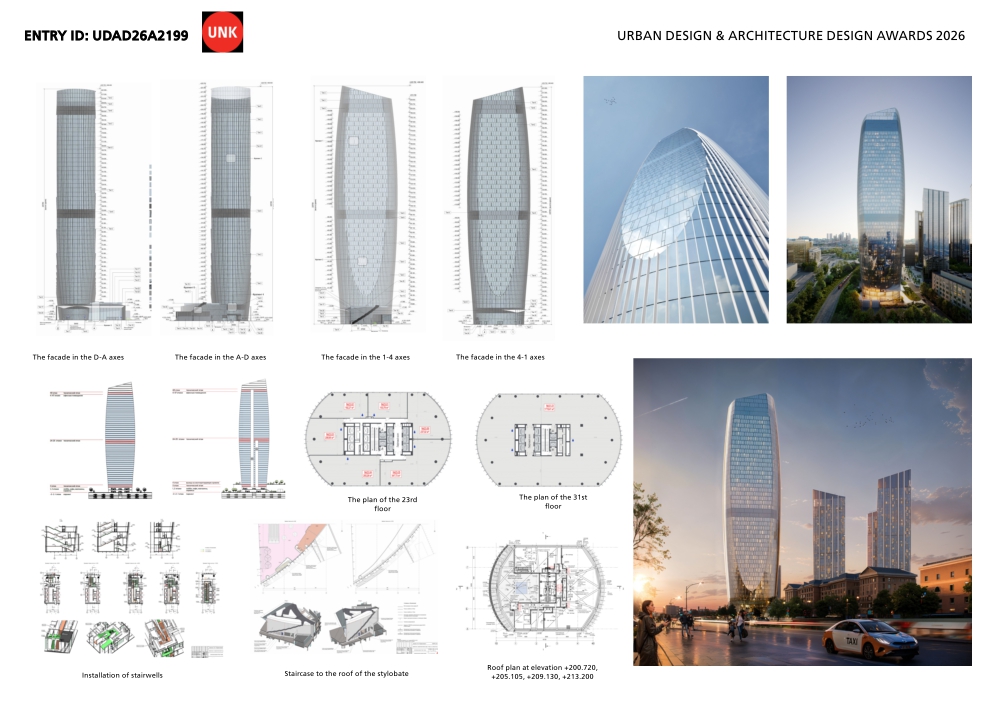
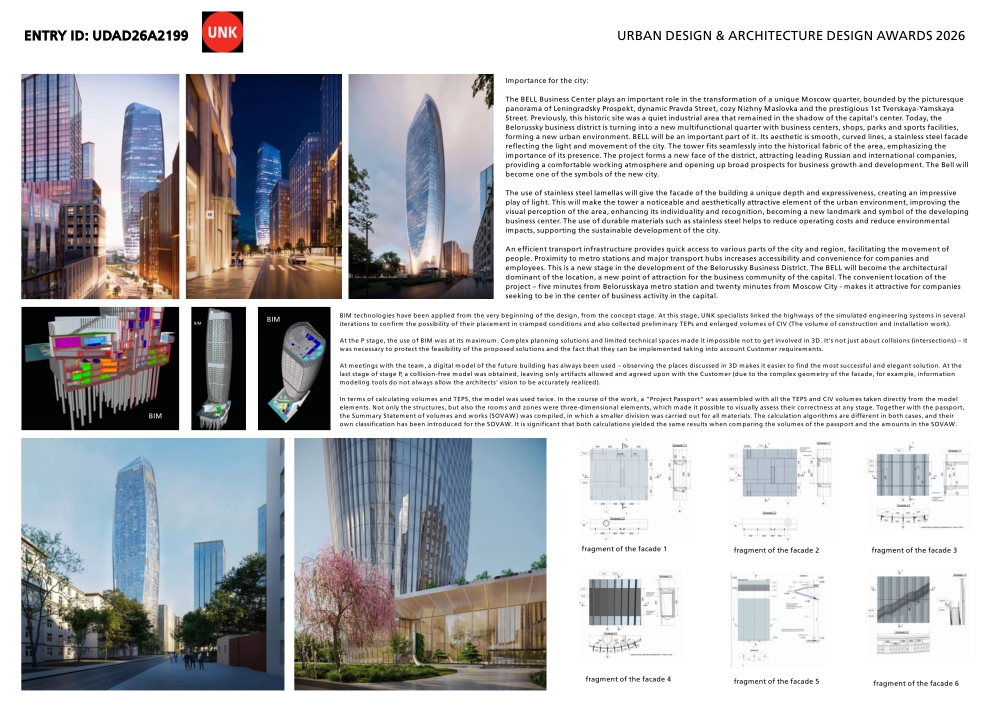
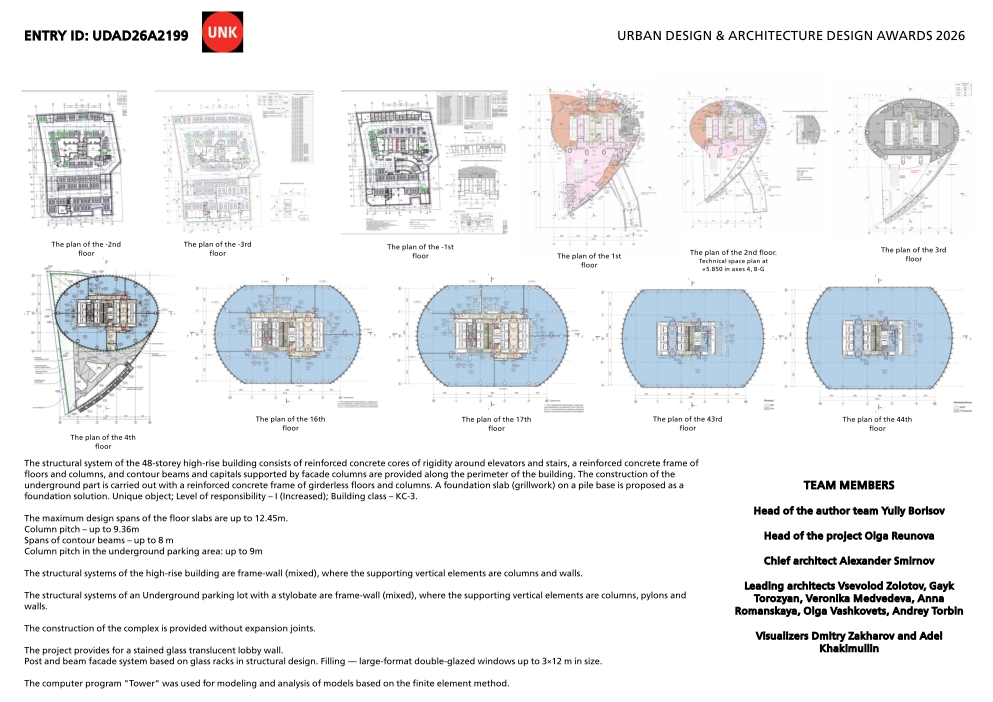
As conceived by the UNK team, the image of the complex symbolizes the winners’ cup, which expands upward, and serves as a reference to the history of the place where the Slava watch factory was located. The facade of the building consists of flat and curved parts. The first of them will be made of structural glazing, using large-format double-glazed windows three meters wide and four meters high. And the facade of the curved part of the building, which currently has no analogues in Russia in shape and size, will be produced by cold bending of glass. The shape of the building will be accentuated by stainless steel lamellas, which, in contrast to the smooth surface, will create the effect of “cut-off” edges.
Modern engineering systems will be installed in the skyscraper, including Face ID access, heat recovery, energy-efficient glazing and «smart» lighting. The underground parking should accommodate 239 cars, it will also be possible to recharge an electric car, the first two floors will be occupied by a lobby, cafes and shops, an outdoor terrace with a place to relax, a work area and an amphitheater will appear on the fourth floor.
At first glance, the Bell skyscraper is strict and concise, although it cannot be called modest in any way. Economical stereometry is based on working with a shape close to an oval – and this is one of the favorite themes of UNK. The streamlined surface of the basic shape with metal lamellae is cut twice with glass sections, graphically demonstrating the essence of the original shape: its simplicity and complexity at the same time. In addition, dozens of complex engineering puzzles have been solved here.
The Bell skyscraper (Class Prime) has a height of 220 meters, 48 ground floors and a three–storey underground parking for 239 cars, its total area is 84,790 m2. Class A guarantees a modern building with high engineering standards, convenient location and well-developed infrastructure, while Prime brings these characteristics to the “best of the best” level: these are skyscrapers in central areas, with architecture from leading bureaus, exclusive interior design, environmental certification, panoramic views, an increased level of service and tenants from global companies. Prime class offices are focused on prestige and image.
The Bell skyscraper resembles a highly elongated spheroid, truncated from two sides by two parallel vertical planes. This form appeared as a response to a technical assignment. The building site is small, bounded on the north by a street, and on the south by a railway. A 20-storey building adjoins it on the east side, and it was necessary to take into account the insolation. The task was complicated by the presence of underground utilities that could not be touched. The idea of an architectural volume expanding upward, standing on a small plateau, suggested itself.
This is an example of how form becomes philosophy. Each floor of the Bell skyscraper is an ellipse truncated from two sides. The sizes of ellipses are unique: they expand along different axes, their radius changes, they tend to form a circle, but they never reach it. And that’s the intrigue: constant movement and variability are “hardwired” into a static architectural body. Additionally, the dynamics are emphasized by two vertical planes that truncate the parametric surface.