

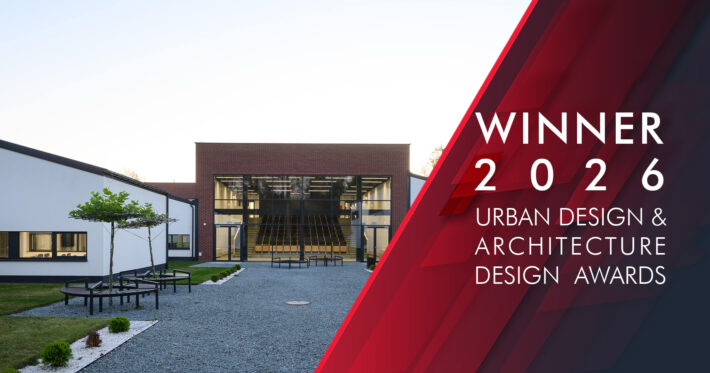
A unique school has been built in the Bielszowice district of Ruda Śląska—modern, functional, and fully adapted to the challenging geological conditions of the region. Located on land degraded by decades of intensive mining activity, the new facility replaces an old prefabricated building that had suffered severe structural damage as a direct result of underground coal exploitation.
Urban Design & Architecture Design Awards 2027: Entries Open!
Take your work to the next level. Register Now…

Gold 🏆 Winner
Urban Design & Architecture Design Awards 2026
Primary School and Kindergarten
Public Building – School
Firm
TKHolding & Hornik Chmura Architektura sp. z o.o.
Architect/Designer
Andrzej Truszczyński, Paweł Kobierzewski, Maciej Obszański, Bartłomiej Hornik, Marek Chmura
Design Team
Andrzej Truszczyński, Paweł Kobierzewski, Maciej Obszański, Wojciech Kupka, Bartłomiej Hornik, Marek Chmura
Location
ul. Szkolna 22, 41-711 Ruda Śląska, Poland
Country
Poland
Photographer/Copyright
©TKHolding


The previous school, constructed during the communist era using prefabricated technology, had become heavily deformed due to long-term mining operations. The exploitation caused ground subsidence and shifts, leading to the tilting of the structure—floor slab inclinations reached up to 5%. These deformations had a significant impact on the building’s daily use: doors would not close properly, movement through the corridors was difficult, and even simple tasks, like pouring soup in the canteen, became problematic. With the safety of students and staff at risk, the decision was made to build a completely new school.
The design of the new facility is based on a modular architectural concept. Instead of a single, compact structure, the school is composed of a series of ground-level segments, each functioning as an independent classroom—resembling a small, self-contained building. This layout allows for individual adjustments to be made to specific parts of the school in response to any future ground movements, without the need to interfere with the entire structure.
Between the segments, green courtyards and atriums have been created—shared spaces that promote relaxation, social interaction, and contact with nature. This arrangement enhances the comfort and well-being of users, creating a friendly and human-centered environment for both students and teachers.
The project was developed in just three months—from the awarding of the tender to the completion of the construction documentation. Simultaneously, continuous geodetic monitoring was carried out during construction. Ground displacements were observed even in the early stages, which required constant cooperation with geologists, surveyors, and representatives from the local mine. Only through a flexible design approach and precise interdisciplinary coordination was it possible to complete the investment in such demanding conditions. The new school in Bielszowice is not only a response to the hazards caused by mining activity but also an example of how architecture can transform damaged and degraded areas into safe, resilient, and inspiring spaces. It is an investment that looks toward the future—not only in terms of infrastructure but also in its commitment to social well-being.