


Located on Playa Revolcadero in Acapulco, Guerrero, Pierre Diamonds emerges as an architectural response to the challenges left by Hurricane Otis in 2023, proposing a coastal revitalization that combines strategic urbanization and environmental regeneration. This development transforms the region’s landscape through a design that reintegrates green areas into the built environment, ensuring a balance between functionality and sensitivity to the natural context.
Urban Design & Architecture Design Awards 2027: Entries Open!
Take your work to the next level. Register Now…

Gold 🏆 Winner
Urban Design & Architecture Design Awards 2026
Pierre Diamonds
Mixed-Use Architecture (Concept)
Firm
Rabago__Architects
Architect/Designer
Arnoldo Rabago
Design Team
Arnoldo Rabago
Location
Acapulco, Guerrero
Country
Mexico
Photographer/Copyright
©Rabago__Architects
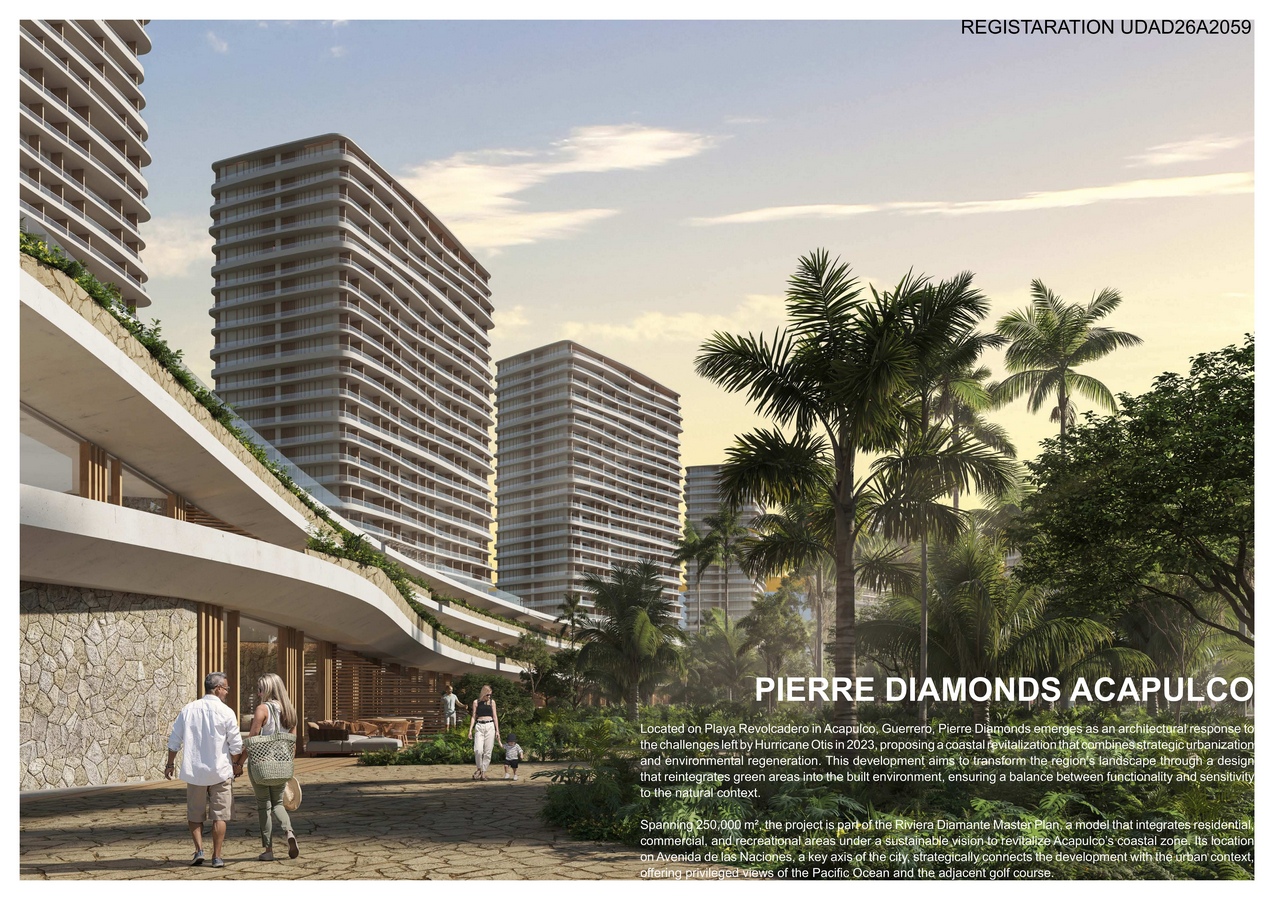
Spanning 250,000 m², the project is part of the Riviera Diamante Master Plan, a model integrating residential, commercial, and recreational areas under a sustainable vision to revitalize Acapulco’s coastal zone. Its location on Avenida de las Naciones, a key urban axis, strategically connects the development to the city, offering privileged views of the Pacific Ocean.
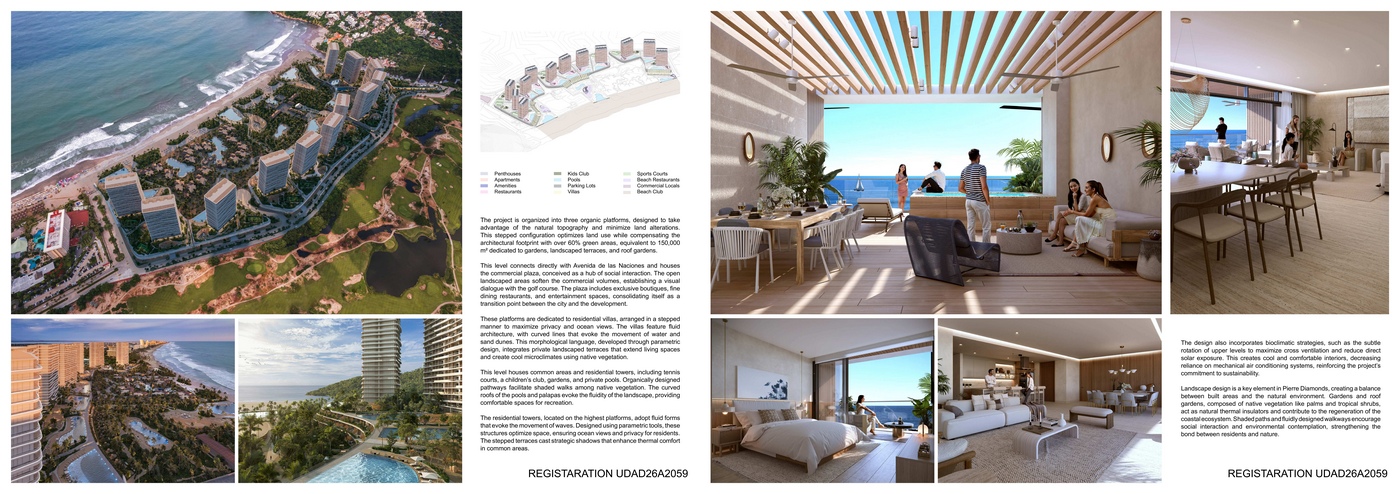
The project is organized into three platforms that follow the natural topography, minimizing alterations. This stepped configuration optimizes land use while compensating the architectural footprint with over 60% green areas, equivalent to 150,000 m² of gardens, landscaped terraces, and roof gardens.
The lowest level, directly linked to Avenida de las Naciones, houses the commercial plaza, conceived as a hub of social interaction. Landscaped areas soften the commercial volumes and establish a dialogue with the golf course. The plaza includes exclusive boutiques, fine dining, and entertainment spaces, consolidating itself as a transition point between city and development.
The middle platforms contain residential villas arranged in a stepped manner to maximize privacy and ocean views. Their fluid architecture, with curved lines evoking water and dunes, is developed through parametric design. Each villa integrates landscaped terraces that extend living areas and create cool microclimates using native vegetation.
The upper platforms host common areas and residential towers with tennis courts, a children’s club, gardens, and private pools. Organically designed pathways weave through native vegetation, while curved roofs and palapas echo the fluidity of the landscape. The residential towers, shaped with parametric tools, optimize space and guarantee privacy and views. Stepped terraces cast shadows that enhance thermal comfort in shared areas.
Bioclimatic strategies include rotating upper levels to maximize cross ventilation and reduce solar exposure, creating interiors that require less mechanical cooling. Landscape design is equally central, with native gardens and roof gardens acting as natural insulators while regenerating the coastal ecosystem. Shaded paths encourage interaction and environmental contemplation, strengthening the bond between residents and nature.
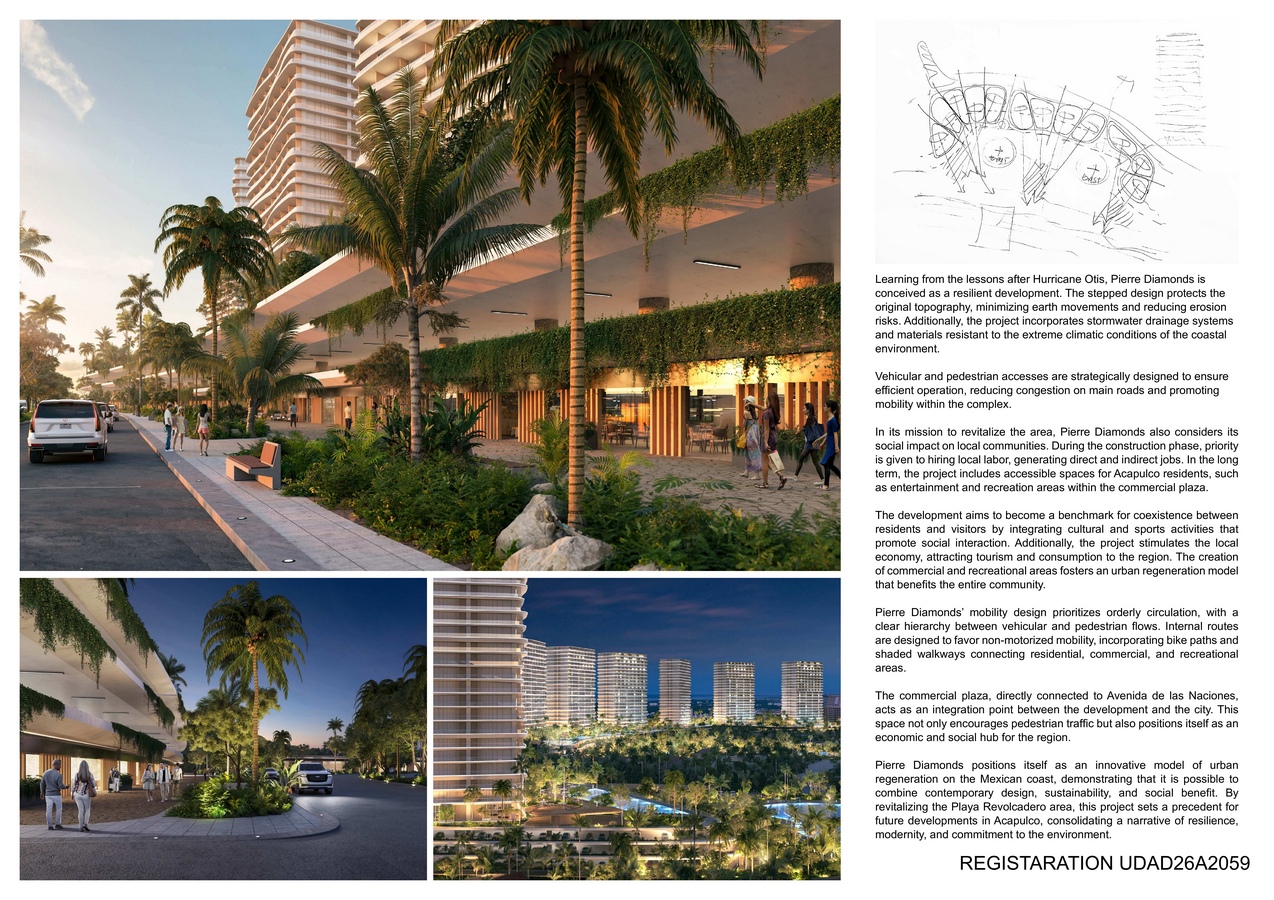
Learning from Hurricane Otis, the project is conceived as resilient. The stepped design preserves topography, minimizing earth movement and erosion. Stormwater systems and climate-resistant materials further ensure durability. Access points are designed to reduce congestion and promote internal mobility.
Pierre Diamonds also addresses social impact. Construction prioritizes local labor, generating jobs, while the commercial plaza includes accessible areas for residents. Cultural and sports activities foster community interaction, and commercial spaces stimulate tourism and the local economy.
By prioritizing non-motorized mobility, shaded walkways, and bike paths, the project integrates residential, commercial, and recreational uses into a cohesive whole. Positioned as an innovative model of regeneration, Pierre Diamonds demonstrates how contemporary design, sustainability, and social benefit can converge to revitalize Acapulco’s coast.