

The Longxing Temple area is located at the historical and geographical center of Pengzhou. Anchored by a thousand-year-old Buddhist temple, the area carries the city’s cultural origins and collective memory, while remaining one of the most active zones of everyday urban life. At the same time, the area suffers from deteriorated housing, obsolete industrial land and insufficient public facilities. For more than a decade, local government has viewed this area as a potential new urban core, yet repeated attempts were delayed by financial constraints and complex demolition conditions.
Urban Design & Architecture Design Awards 2027: Entries Open!
Take your work to the next level. Register Now…

Gold 🏆 Winner
Urban Design & Architecture Design Awards 2026
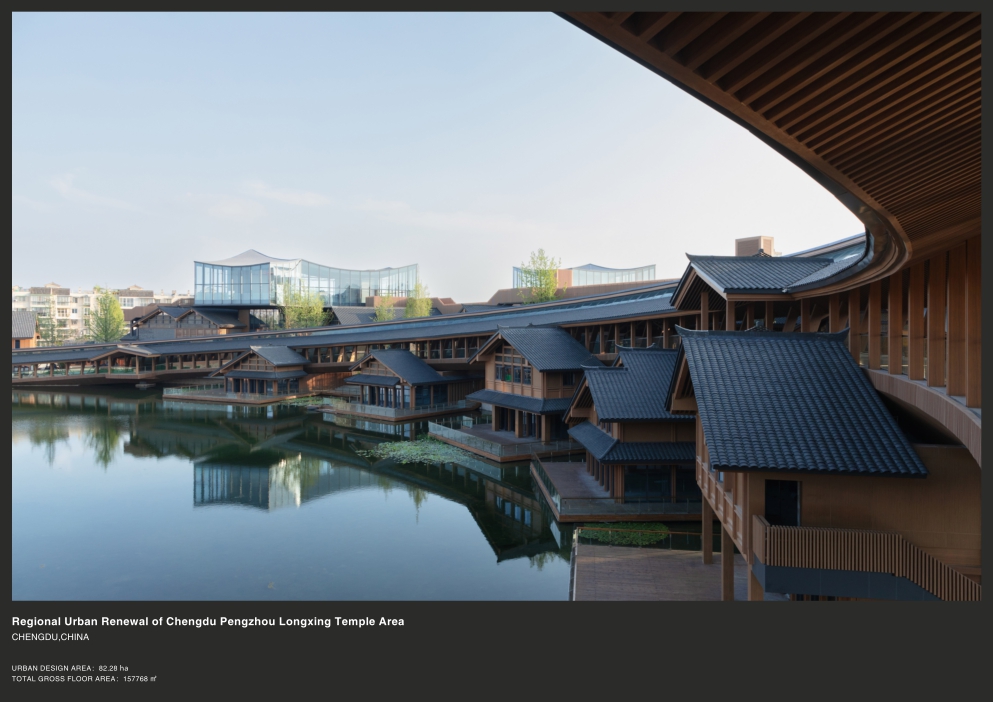
Regional Urban Renewal of Chengdu Pengzhou Longxing Temple Area
Urban Design (Built)
Firm
BIAD-ASA Studio
Architect/Designer
Luoyi Yin
Design Team
Leader designer:Luoyi Yin Urban planning/Urban Design: Shengnan Guo, Xiaofeng Zhang, Wei Li, Xinda Tang, Shuang Luo, Xiyun Shang Architectural design: Feng Xu, Xiangyuan Kong, Fangfei Chen, Li Cheng, Ning Ni, Jianwei Li, Haonan Wang Landscape design: Ling Ding, Di Su, Xue Zhai, Jie Yang, Yixin Chen Commercial space design: Xin He, Jianxian Lin, Shuwen Luo, Ping Wang Interior design: Jianjun Li, Xiangyuan Kong Construction drawing design: Construction drawings for ABE plot buildings:Xianrong Li, Wei Li, Wei Gao, Bo Zhang, Jianhao Song / Construction drawings for CD plot buildings: Hong Zhou, Run Zhou, Wei Kong, Na Zhao, Yan Pei, Yuexing Wang, Sijia Li, Peng Yang, Xiangyu Wang / Structural construction drawings: Shichang Duan, Longgui Bu, Zhijun Gao, Yiqiao Tang, Juehui Xing, Litao Wang, Zixuan Bai / Construction drawings for water. electricity, HVAC equipment: Liang Sun, Peng Liang, Jiashan Zheng, Mo Zhang, Meng Zhao, Boxuan Yan Business plan: CUSHMAN & WAKEFIELD, Zhongying Renhe (Beijing) Commercial Management Co., Ltd Interior design consultants: ARCHIEE PARIS, SHARING Landscape design consultants: R-land Signage design: FERRCTAL Lighting design: TUNGSTEN Green Building Design: Architectural Design & Research Institute of Tsinghua University Cultural heritage consultants: Renovation History Conservation Office, Shanghai
Location
Pengzhou,Chengdu,China
Country
China
Photographer/Copyright
©arch-exist
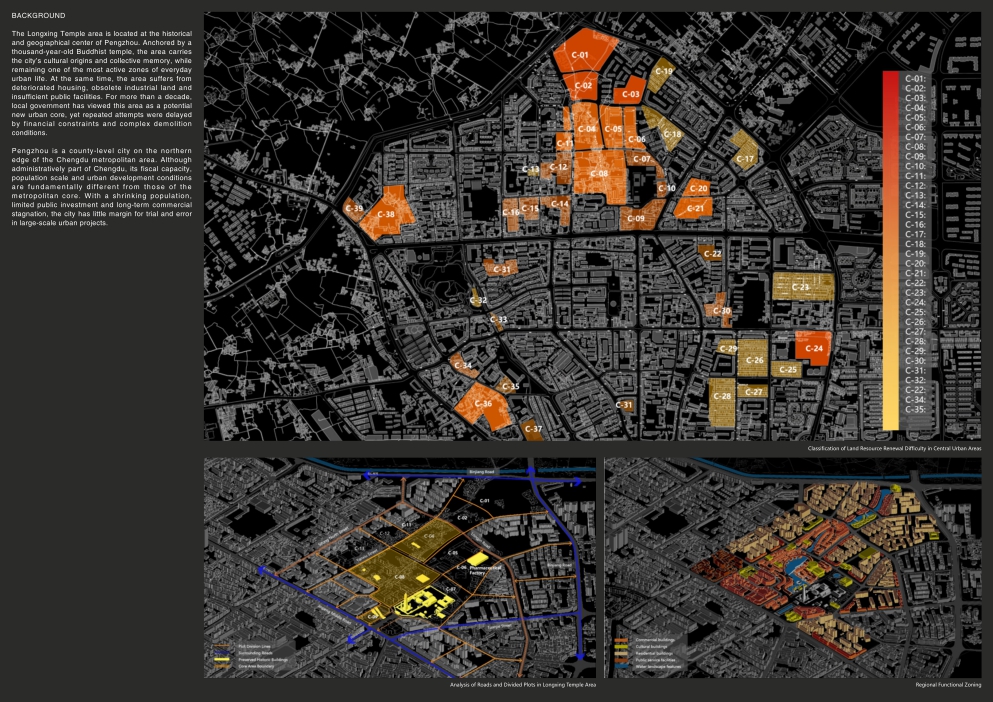
Pengzhou is a county-level city on the northern edge of the Chengdu metropolitan area. Although administratively part of Chengdu, its fiscal capacity, population scale and urban development conditions are fundamentally different from those of the metropolitan core. With a shrinking population, limited public investment and long-term commercial stagnation, the city has little margin for trial and error in large-scale urban projects.
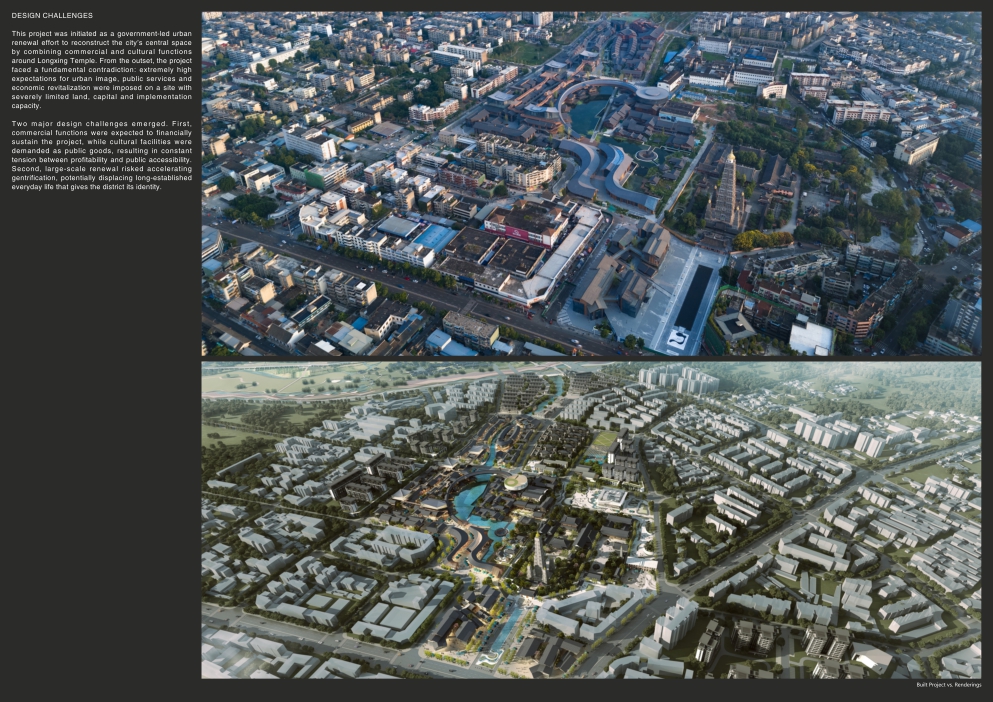
This project was initiated as a government-led urban renewal effort to reconstruct the city’s central space by combining commercial and cultural functions around Longxing Temple. From the outset, the project faced a fundamental contradiction: extremely high expectations for urban image, public services and economic revitalization were imposed on a site with severely limited land, capital and implementation capacity.
Two major design challenges emerged. First, commercial functions were expected to financially sustain the project, while cultural facilities were demanded as public goods, resulting in constant tension between profitability and public accessibility. Second, large-scale renewal risked accelerating gentrification, potentially displacing long-established everyday life that gives the district its identity.
In response, the design adopted a dual-balance strategy, addressing both development costs and long-term operation. A compact government-led core area was defined, while surrounding land was released to offset demolition and construction costs. Within the core, commercial and cultural programs were recalibrated to ensure that commercial revenue could support the operation of non-profit cultural facilities.
Spatially, commercial and cultural spaces were neither fully separated nor fully mixed. Through functional segmentation and integrated circulation systems, the project sought to maintain the efficiency of commercial movement while allowing slower, more exploratory cultural routes. This approach aimed to manage conflict rather than eliminate it.
Rather than offering a universal model, the project reflects a high-risk but necessary attempt by a resource-limited city to renegotiate the relationship between economic logic, public space and urban identity.