

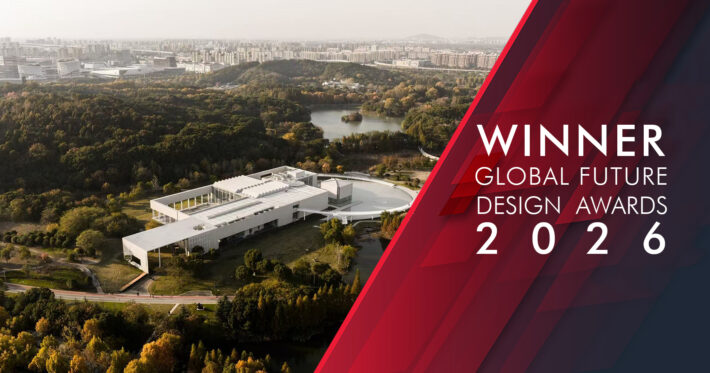
Nestled in Shenshan Park in the downtown area of Wuhu, Anhui Province, the Art Museum of the China Sculpture Institute is an urban renewal project renovated from a disused greenhouse. Its home, Wuhu Sculpture Park, stands as China’s first thematic art space that organically integrates sculpture culture with natural landscapes.
Global Future Design Awards 2027 — Entries Now Open!
Take your creativity to the global stage and showcase your innovative ideas to the world. Celebrate exceptional design, gain international recognition, and become part of a new generation shaping the future of design.
Submit Your Work Today & Take Your Design Journey to the Next Level!
Gold 🏆 Winner
Global Future Design Awards 2026
ART MUSEUM OF THE CHINA SCULPTURE INSTITUTE
Cultural Architecture Built
Firm
Beijing China Virtue Architectural Design Co., Ltd.
Architect/Designer
Chunli Zhang
Design Team
Jianyang Liu, Yihan Dong, Xianna Shi, Yukun Gong, Jia Zhang, Qingfeng Sun, Liuliu Li, Chenyu Li, Yuanqing Zhang, Junli Shao, Lei Meng, Jiating Qin
Location
Wuhu Sculpture Park (Shenshan Park), Jiujiang District, Wuhu City, Anhui Province, China
Country
China
Photographer/Copyright
©TOPIA: Yonggang Zhong, Xianyi Xu
Website/Social Media handles
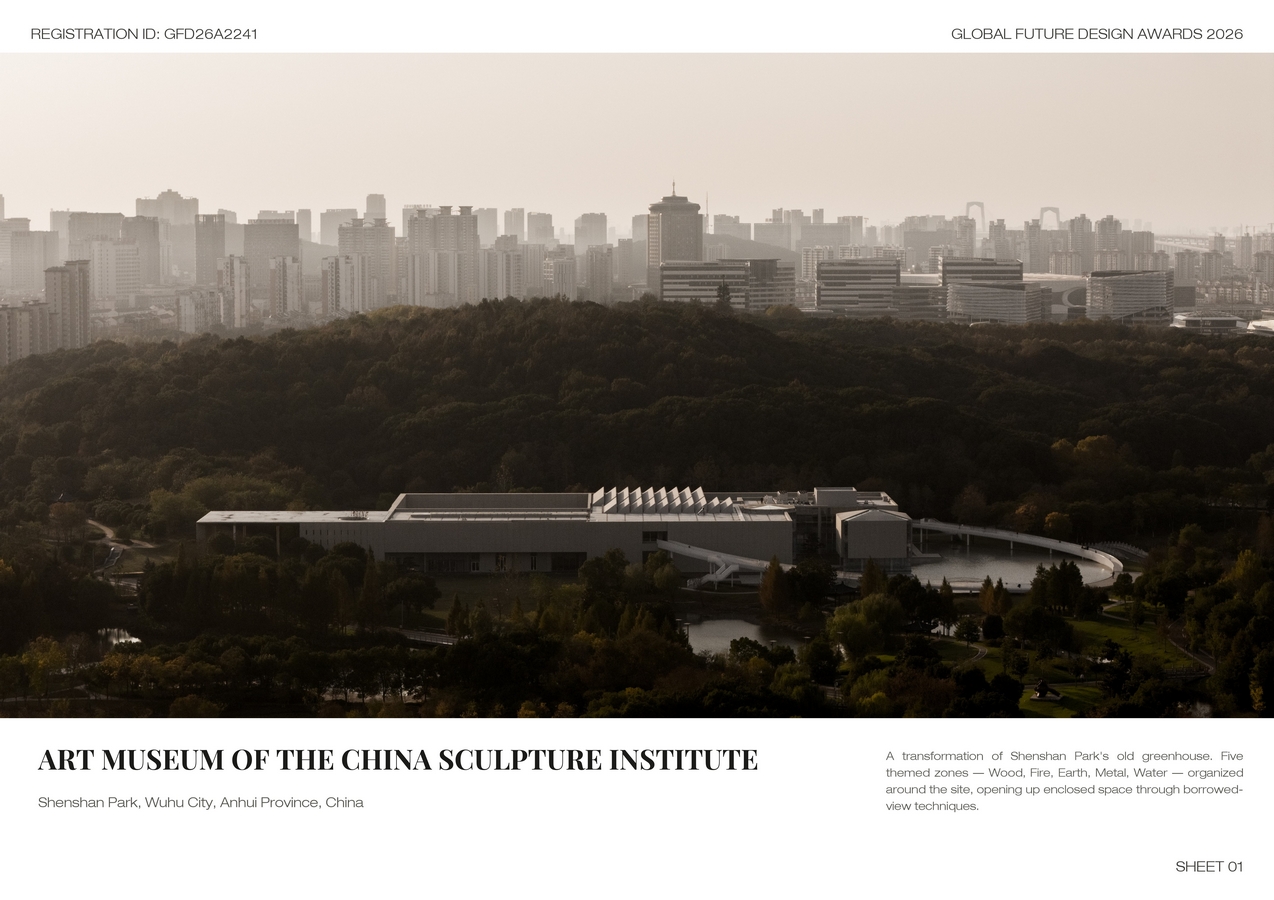
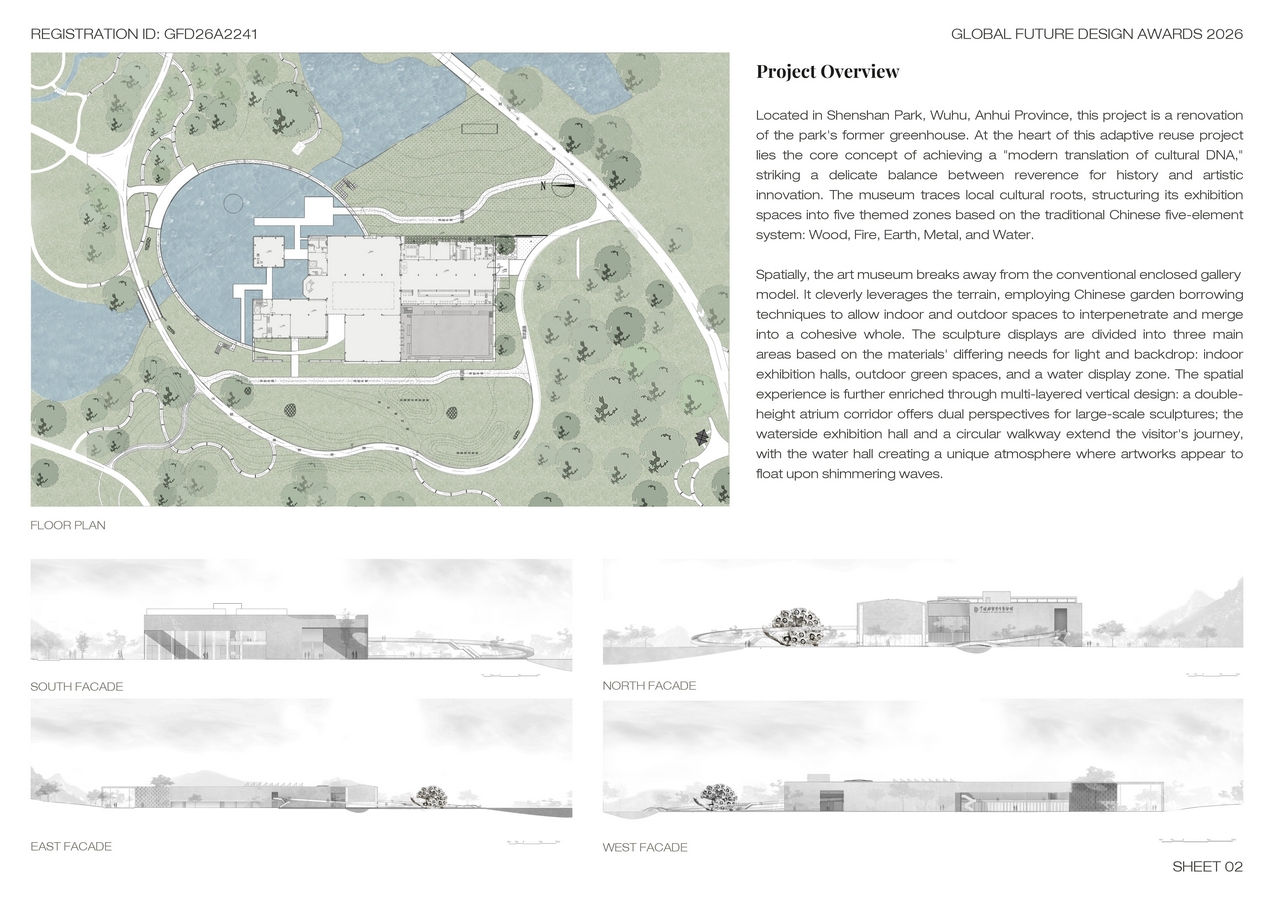
“Jiuzi” is the ancient name of Wuhu, signifying “Jiuzi bird perching by the water, brimming with vitality”. Drawing inspiration from the imagery of “Jiuzi bird alighting on the waterfront”, the art museum echoes the local natural and historical heritage. In accordance with the traditional Chinese five-element theory (Wuxing), the exhibition area is divided into five thematic sections corresponding to Wood, Fire, Earth, Metal, and Water. More than a mere classification system for material forms, the five-element theory represents a cognitive framework centered on movement, transformation, and interconnection. The museum adopts the five states embodied by the elements—Metal (convergence), Wood (growth), Water (permeation), Fire (dissolution), and Earth (integration)—to construct a narrative structure where sculptures and space interact and resonate with each other.
II. Design Approach and Urban Integration
Breaking free from the closed exhibition model, the art museum has transformed into an open urban cultural hub. The design preserves the original architectural form and skillfully adopts the “borrowed scenery” technique of classical Chinese gardens, striving to blur the boundaries between architecture and nature. This approach allows the exhibition spaces inside and outside the venue—including indoor galleries, outdoor green spaces, and waterfront exhibition areas—to permeate one another, forming a harmonious and interconnected exhibition field. The space is activated three-dimensionally both vertically and horizontally: natural light filtering through side windows creates soft illumination; elevated winding corridors offer unique bird’s-eye views of large-scale sculptures; and the water-adjacent exhibition halls together with circular pathways further extend the viewing circulation. Collectively, these elements evoke a visual poetry where artworks seem to float amidst light, shadow, and rippling water.
III. Sustainable Construction and Cultural Empowerment
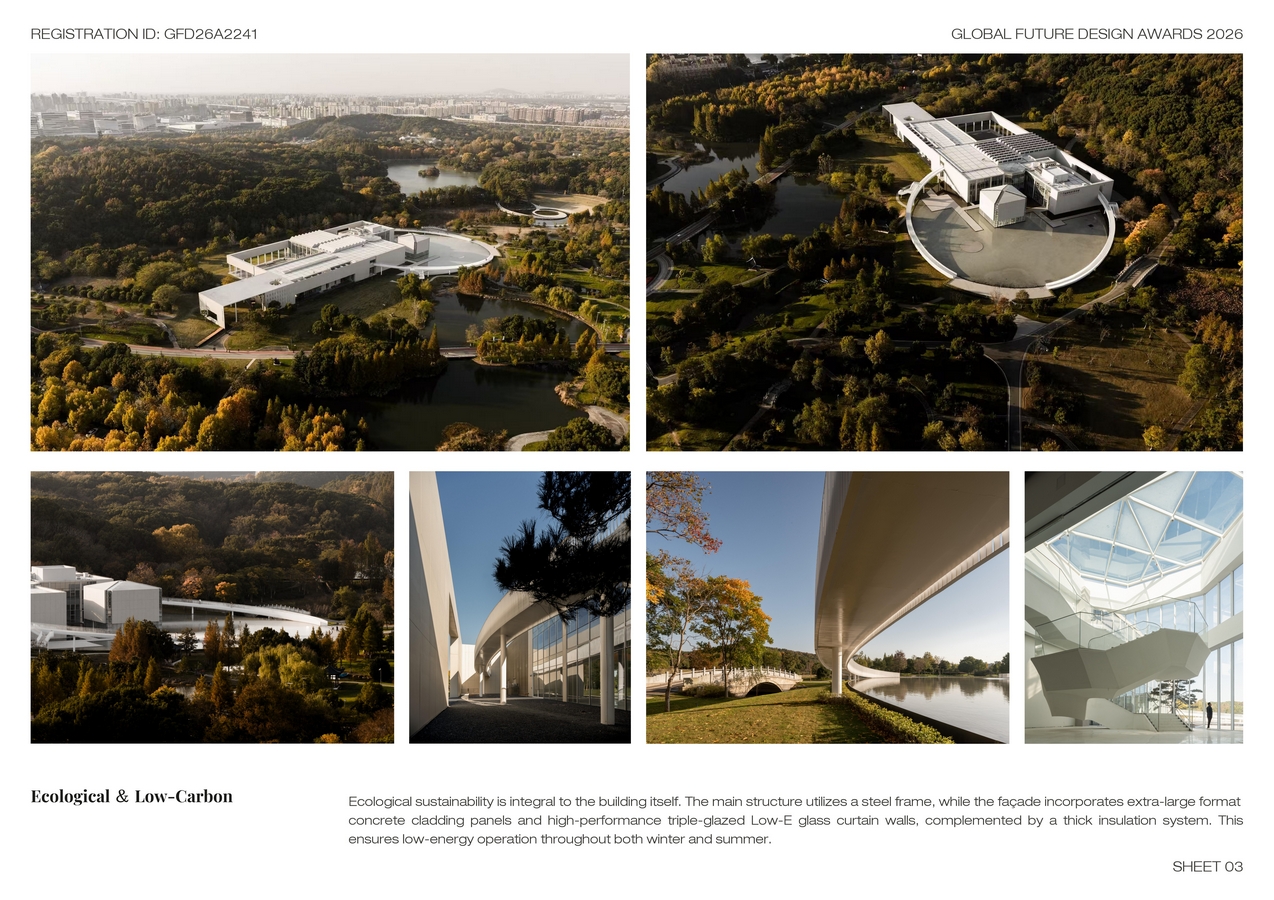
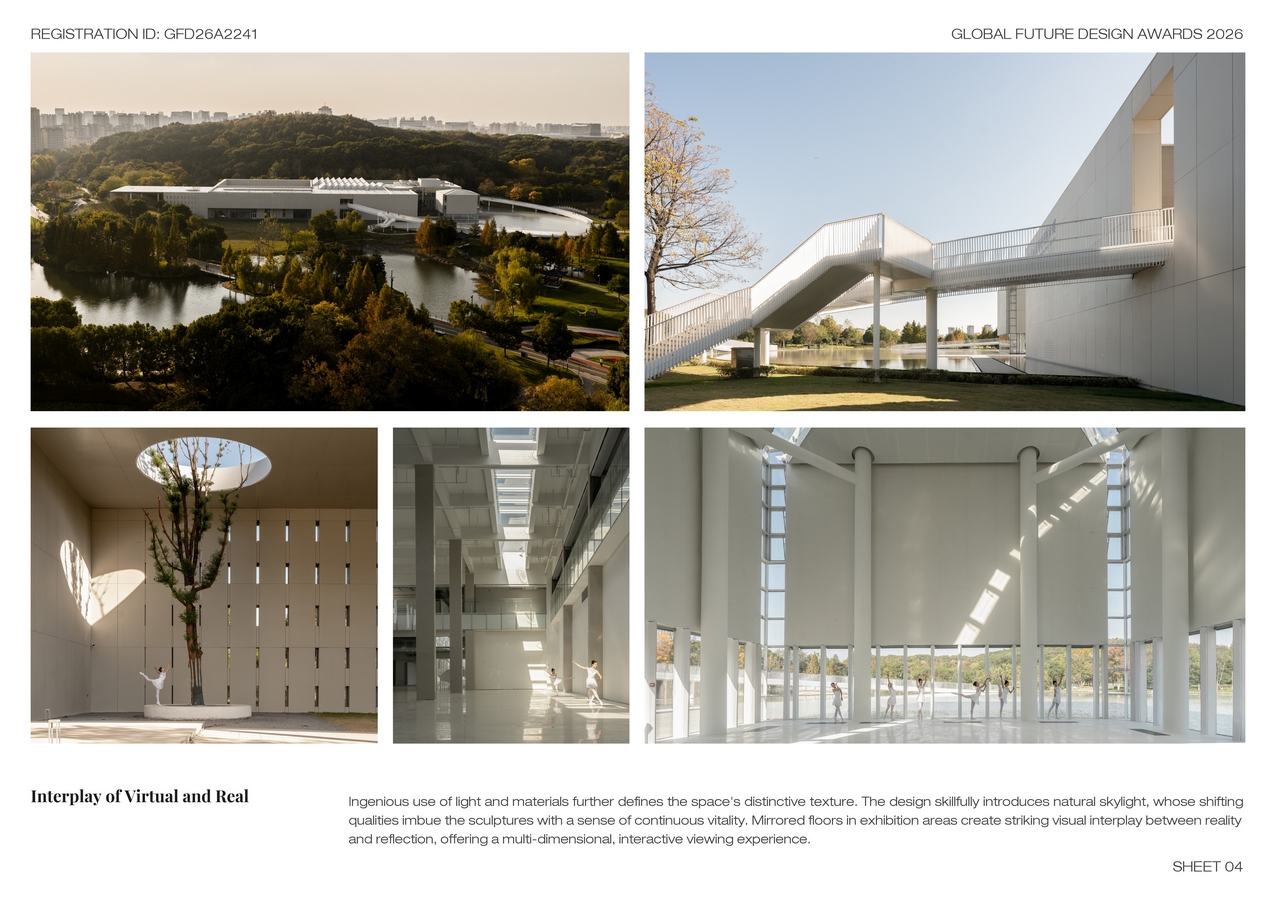
The art museum fully embodies the eco-friendly concept throughout its construction process. The main structure adopts a steel frame system, and the facade integrates extra-large concrete hanging panels with triple-glazed Low-E glass curtain walls, paired with a high-efficiency thermal insulation system to achieve low-energy consumption operation. The design also makes full use of natural elements: the shifting skylight and cloud shadows across time endow static sculptures with dynamic vitality; meanwhile, the mirrored flooring, through the interplay of virtual and real reflections, expands the physical dimensions of the space and enriches the viewers’ sensory experience. As a result, the building itself becomes a giant sculpture that interacts harmoniously with the surrounding mountains, water systems, vegetation, and light. Like a “time sculpting machine”, it continuously explores the infinite possibilities among nature, architecture, and art.
IV. Urban Renewal Driven by Cultural Renaissance
Through the “modern translation of cultural heritage”, the Art Museum of the China Sculpture Institute strikes a balance between reverence for history and artistic innovation. It has evolved from a static “container for viewing” into a dynamic “cultural generator”, upgraded from a resource-consuming “cost center” to a value-creating “economic hub”, and transformed from an enclosed “palace for elites” into an open “community living room”. Leveraging its magnetic effect as a cultural landmark, the museum reshapes the value chain of urban space, turning art from a luxury “collection” into a daily “optimal solution”. When urban space becomes a “living organism” for cultural growth, the sustainable development philosophy of “innovating while honoring history” truly gains vitality.
Follow us on