


The Astronomy and Space Science Gallery—India’s largest of its kind—is part of Gujarat Science City, a State Government initiative to promote scientific awareness and foster a spirit of inquiry among citizens. Standing alongside the Aquatic and Planet Earth Galleries, it forms a symbolic triumvirate of earth, water, and space.
Urban Design & Architecture Design Awards 2027: Entries Open!
Take your work to the next level. Register Now…

Gold 🏆 Winner
Urban Design & Architecture Design Awards 2026
Astronomy and Space Science Gallery, Science City, Ahmedabad
Public Building (Built)
Firm
INI Design Studio
Architect/Designer
Jayesh Hariyani
Design Team
Adi Mistri, Saumil Mevada, Rakhi Rupani, Bhargav A Bhavsar, Parth Joshi
Location
Science City, Ahmedabad, Gujarat, India
Country
India
Photographer/Copyright
©Vinay Panjwani, India


The architectural vision of the gallery draws direct inspiration from the forms, motions, and patterns of the cosmos—the very subject it celebrates. The visitor journey unfolds as a layered, story-rich exploration—from the familiar Solar System through galactic neighbourhoods to the farthest frontiers of space—each designed as an immersive environment that combines physical exhibits, augmented reality, and multimedia storytelling.
An Easily Navigable Layout Inspired by the Solar System:
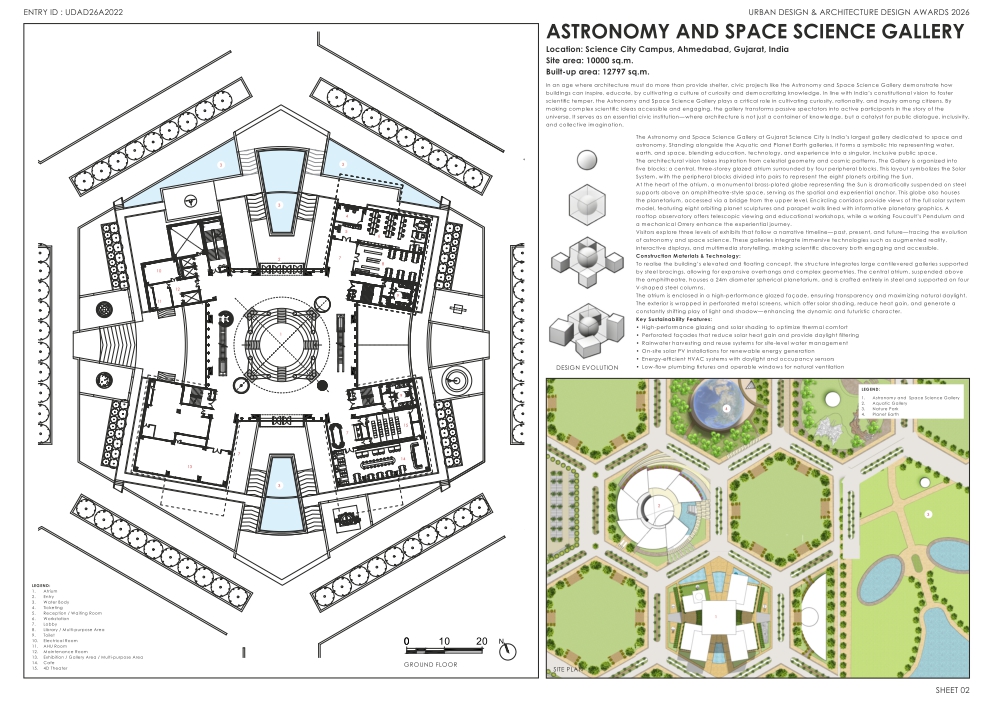
The design organises the Gallery into five distinct blocks: a central atrium enclosed in a transparent glazing system and rising three floors high, surrounded by four peripheral blocks. This configuration forms a powerful architectural metaphor for the Solar System, with the four surrounding blocks subdivided into pairs to symbolise the eight planets. At the centre of the atrium, a monumental brass-plated globe representing the Sun, is dramatically suspended on peripheral steel supports above an amphitheatre-style event space, serving as the spatial and experiential anchor for visitors. It houses the planetarium, accessed via a bridge at the upper level. Encircling corridors on the upper floors provide views of the complete solar system model, with eight planet sculptures orbiting the globe, while parapet walls are lined with informative graphics about each planet. An observatory allows direct interaction with the cosmos through telescopic viewing and educational workshops, while a working Foucault’s Pendulum and a mechanical Orrery deepen the sense of cosmic wonder.
From the central atrium, visitors follow a choreographed journey through three levels of galleries within the peripheral blocks, which are thematically organised along a timeline that explores the past, present, and future of astronomy and space science. Immersive interiors, interactive installations, and audio-visual media combine education and entertainment, while outdoor exhibits and observation decks bring the cosmos closer to the public.
Materials and Construction technology:
To achieve the vision of the elevated, floating concept and dynamic form, the structure incorporates large, cantilevered galleries supported on steel bracings, and a vast central atrium spanning 38 x 38m that houses a 180-seat planetarium within a 24m diameter dome.
The spherical steel planetarium is suspended above the amphitheatre, supported solely by four V-shaped steel columns. The atrium is enclosed in a high-performance glazed envelope for transparency and daylighting, while the building exterior is wrapped in perforated metal screens, which provide solar shading, reduce heat gain, and create a dynamic façade that plays with light and shadow, reinforcing its floating, futuristic character.
Sustainability features:
TheGallery is designed to meet the highest global sustainability standards, with strategies including solar shading, high-performance glazing system, rainwater harvesting and reuse, high-efficiency central cooling, solar PV, water-efficient plumbing, operable windows, and daylight sensors. Together, these features ensure that the gallery reflects both scientific progress and environmental responsibility.