

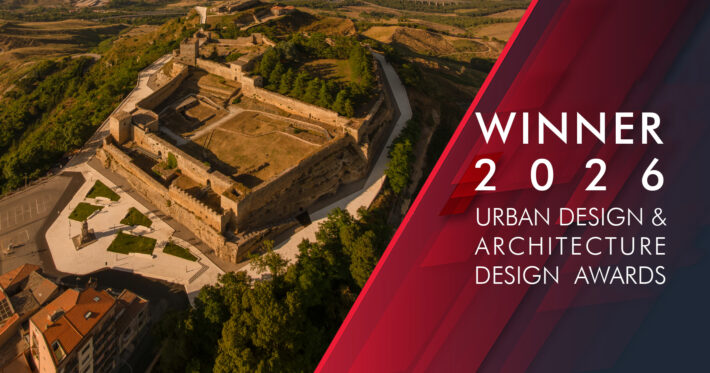
The project focuses on the urban regeneration of the perimeter spaces surrounding the Castello di Lombardia, one
of Sicily’s most important medieval fortresses, located at the highest point of the city of Enna. Over time, these areas had become fragmented and dominated by vehicular infrastructure, weakening the relationship between the historic walls, the city, and the surrounding landscape.
Urban Design & Architecture Design Awards 2027: Entries Open!
Take your work to the next level. Register Now…

Gold 🏆 Winner
Urban Design & Architecture Design Awards 2026
Urban Regeneration of Viale Nino Savarese and Piazza delle Rimembranze. Castello di Lombardia
Urban Design (Built)
Firm
Andrea Caporali studio OMPHALOS
Architect/Designer
Andrea Caporali
Design Team
Andrea Caporali, Roberta Andaloro, Adriano Furma
Location
Enna, Sicily, Italy
Country
Italy
Photographer/Copyright
©Fernando Guerra | FG + SG
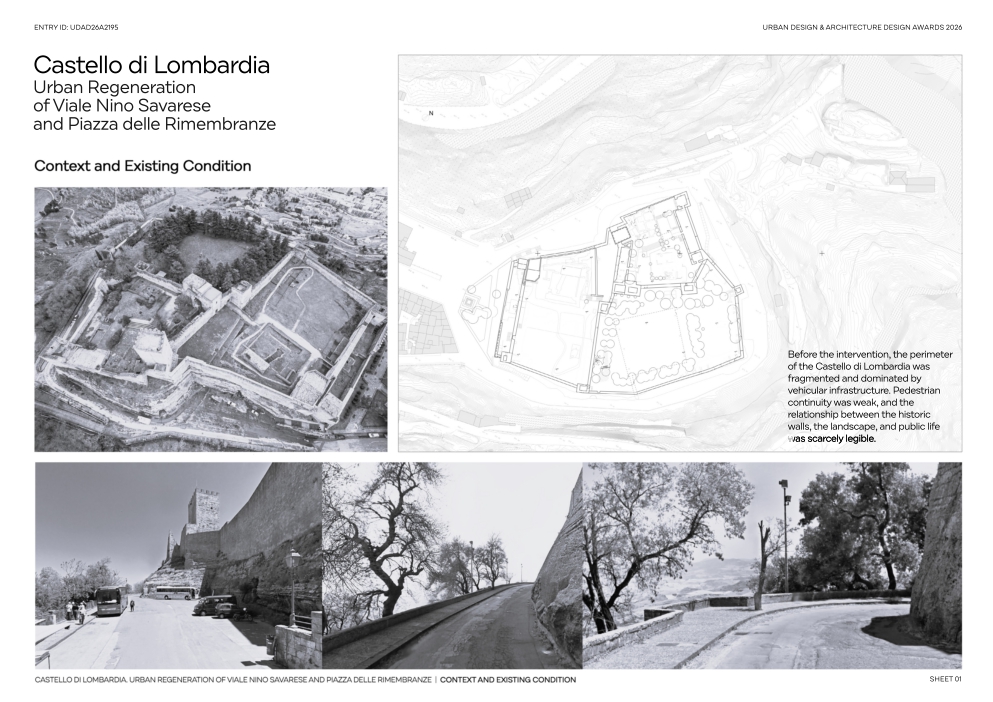
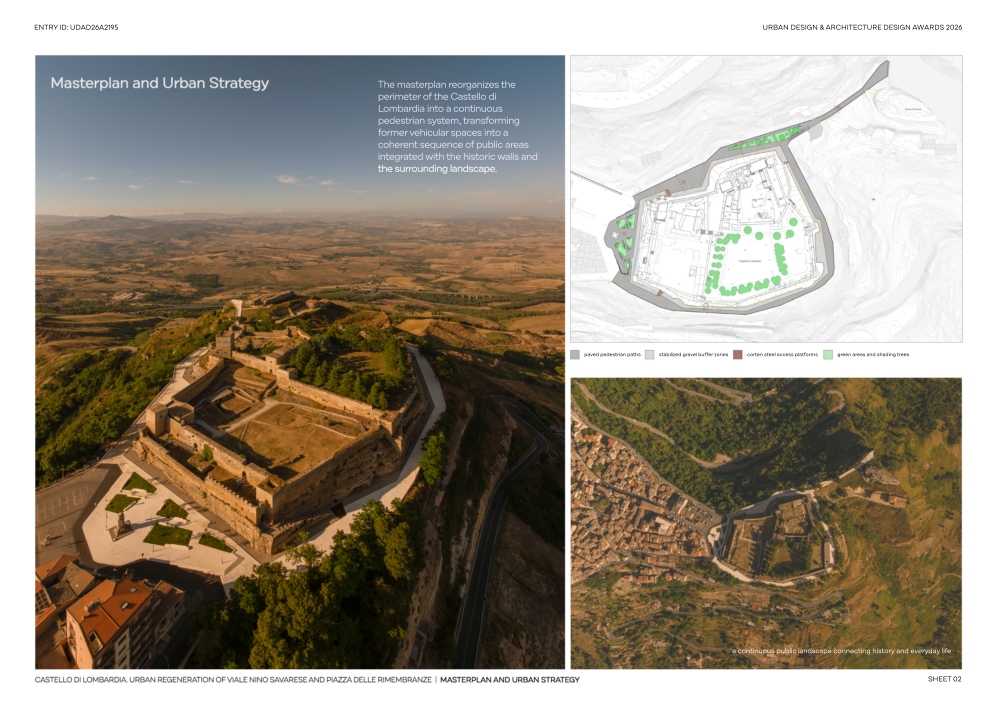
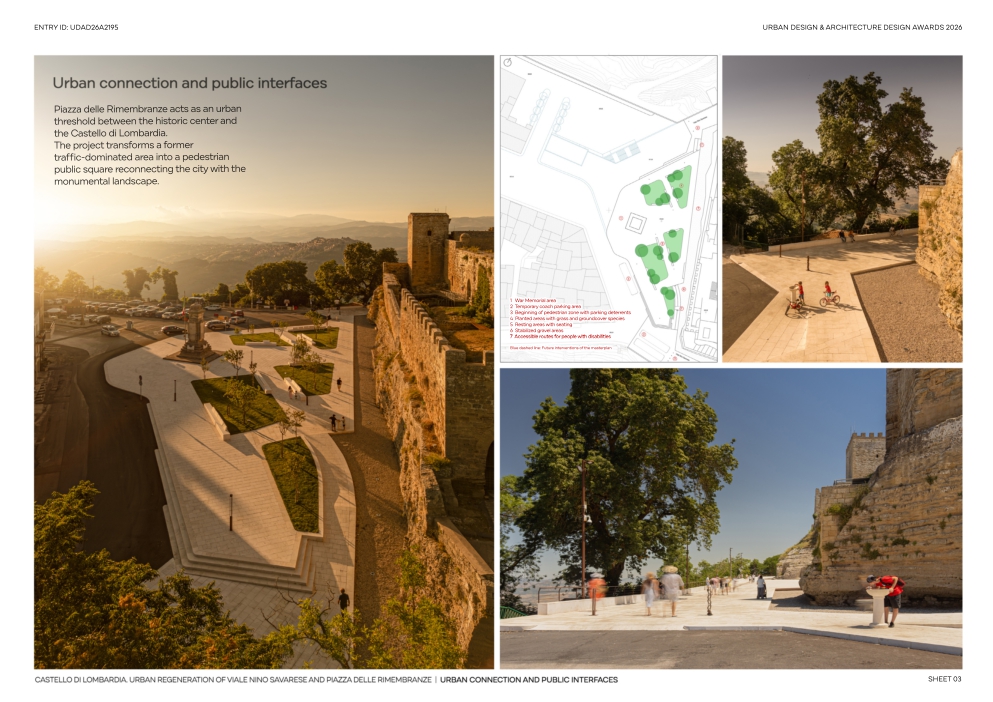
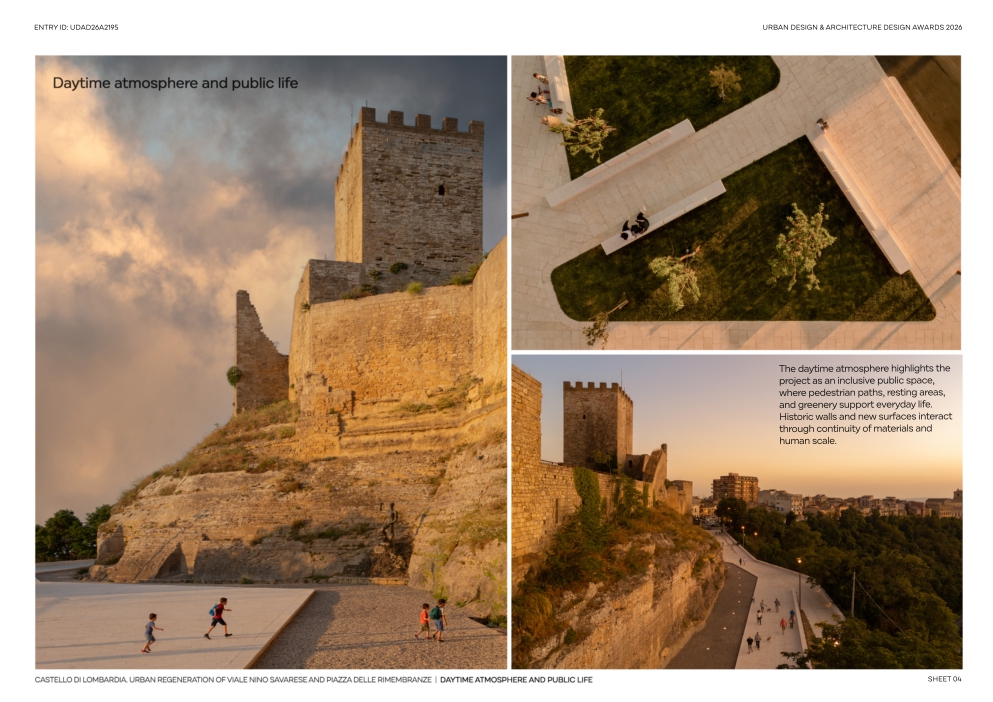
The intervention transforms this condition through a comprehensive strategy that redefines former traffic-dominated spaces as a continuous public landscape. Viale Nino Savarese and Piazza delle Rimembranze are reorganized into an integrated pedestrian system, restoring continuity between the historic center and the monumental complex and re-establishing the Castello as a central civic space within everyday urban life.
At the urban scale, the masterplan prioritizes pedestrian movement while reducing vehicular impact along the castle perimeter. A continuous paved path runs along the historic walls, reconnecting previously disconnected areas and enabling new forms of slow mobility and public use. The project follows existing topography and historical traces, reinforcing a dialogue between architecture, landscape, and terrain rather than imposing new geometries.
Piazza delle Rimembranze acts as a key urban threshold. Once primarily a roundabout and parking area, it is transformed into a pedestrian public square that mediates between the city and the monument. Green areas, shaded seating, accessible paths, and resting platforms encourage daily use while preserving strong visual connections with the castle walls.
Material choices are intentionally restrained and context-driven. Local Perlato di Sicilia stone ensures continuity with the historic fabric, while corten steel elements are introduced selectively as platforms and interfaces between new surfaces and the ancient walls. These contemporary insertions are conceived as lightweight and reversible, clearly distinguishable from the historic structure. Stabilized gravel and planted areas further soften the transition between architecture and landscape.
Accessibility is central to the project. Continuous paths, gentle slopes, and resting areas allow inclusive use by people of all ages and abilities. Public seating and shaded zones support prolonged occupation across different times of the day.
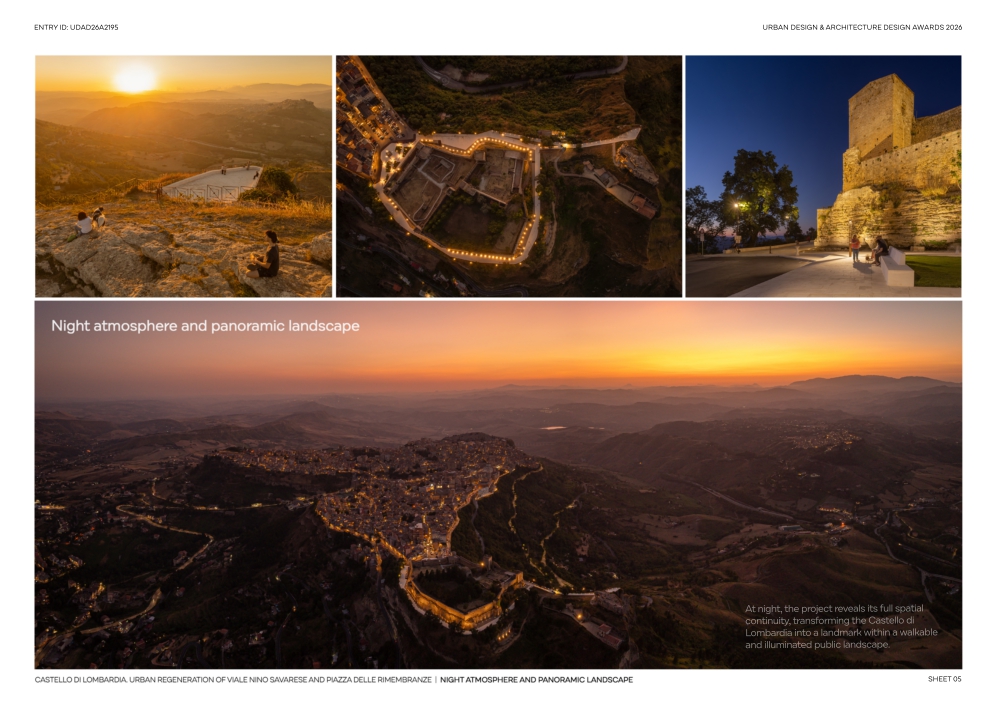
At night, a discreet lighting system traces the pedestrian routes and the perimeter of the castle, enhancing safety and transforming the Castello di Lombardia into a recognizable landmark within the wider territorial landscape. The project reveals its full spatial continuity after sunset, offering a walkable public promenade suspended between city and countryside.
Overall, the intervention proposes a contemporary approach to heritage regeneration, where conservation, accessibility, and public life converge. The Castello di Lombardia is redefined not only as a monument to be observed, but as a lived public space at the heart of Enna.